How to Choose the Right Collated Nails for Your Nailer and Project

Content

  1. Start with Your Nailer

  2. Match Nails to the Task

  3. Understand Nail Features

  4. Collation Types

  5. Common Nail Sizes and Their Applications
  6. Compatibility and Buying Tips

Choosing the correct collated nails is critical to ensure compatibility with your nailer and structural integrity for the task at hand. Incorrect nail selection can lead to tool malfunction, compromised fastening, and inspection failures. This guide is intended for professionals who need accurate, technical information when selecting nails for specific tools and applications.

Start with Your Nailer

Begin by identifying the exact model of your nail gun. Each nailer is designed to accommodate nails of specific angles, collation types, lengths, and gauges. Most framing nailers, for instance, operate at fixed collation angles - 21° , 28° , 30° , or 34° . Using a nail with the wrong angle or collation method can result in feed failures or jams.

Key Specifications to Check

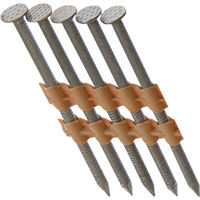
  • Collation angle (e.g., 21° for full round head plastic strip nails)
  • Collation material (plastic, wire, paper)
  • Nail length range (e.g., 2" to 3-1/2")
  • Shank diameter (e.g., 0.113" to 0.148")
  • Magazine type (strip or coil)
  • Operating pressure range (ensure the nail length doesn't exceed pressure specs)

Refer to the manufacturer manual or label on the tool body to confirm these specs.
Match Nails to the Task

Application

Framing

Roofing

Nail Type

21° plastic collated, full round head

15° wire coil

Length

Up to 3-1/4"

1" to 1-3/4"

Shank Type

Ring or screw

Smooth

Head Type

Full round

Large flat

Notes

Required for structural integrity, often code-mandated

Use galvanized nails for shingle retention and corrosion resistance

Application

Decking & Siding

Finish Work

Nail Type

15° or 28° wire/plastic collated

16 or 15-gauge finish nails

Length

2" to 2-1/2"

1-1/4" to 2-1/2"

Shank Type

Ring

Smooth

Head Type

Full round or clipped

DA-type or FN-type

Notes

Stainless or double hot-dip galvanized for outdoor durability

Typically paper-collated at 34°; used in trim, molding, and cabinets

Understand Nail Features

Shank Type

Smooth shank nails offer minimal resistance during driving, making them easier to install quickly, but they have lower holding power and are more prone to pull-out under load.

Ring shank nails feature annular rings along the shaft, increasing friction and making them suitable for sheathing and softwood applications where withdrawal resistance is critical.

Screw shank nails, which have a helical thread, provide superior holding strength and are typically used in decking or other load-bearing installations where long-term stability is required.

Head Type

Full round head nails provide maximum holding strength and are often mandated by building codes, especially in seismic or high-wind zones. They distribute load more evenly and reduce the risk of pull-through.

Clipped or D-head nails allow for higher magazine capacity due to their reduced head size, which is advantageous for speed and efficiency on the jobsite, though they may not meet code in all jurisdictions.

Coating

Vinyl-coated nails drive more easily due to reduced friction, but offer minimal corrosion resistance, making them suitable only for interior applications.

Galvanized nails are coated with zinc to resist rust and are available in various thicknesses (e.g., G90 or G185); these are recommended for most exterior applications.

Stainless steel nails provide the highest corrosion resistance and are essential when fastening ACQ-treated lumber, cedar, redwood, or when working in marine or coastal environments.

Collation Types


Plastic Strip

Paper Strip


Plastic Strip Collation

Paper Strip Collation

Description

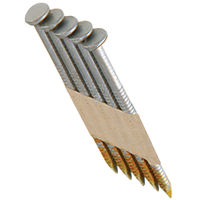
Rigid plastic strip holds nails, typically at a 21° angle.

Bonded paper strip creates a cleaner-firing assembly.

Common Nailers

21° Framing Nailers

30°–34° Framing Nailers

Typical Used For

Structural framing, wall studs

Tight space framing, interior framing

Performance Notes

Durable and jobsite-ready, but leaves plastic debris

Cleaner finish; not moisture-resistant


Wire Coil

Adhesive/Glue Strip


Wire Coil Collation

Glue Collated Finish Nails

Description

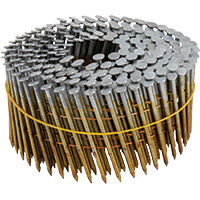
Nails coiled in a circular format and bound with wire.

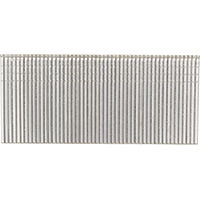
Small nails held together with adhesive or resin glue.

Common Nailers

Coil Roofing & Siding Nailers

Finish NailersBrad Nailers

Typical Used For

High-speed roofing, siding, decking

Trim work, cabinetry, molding

Performance Notes

High magazine capacity; fast firing

Precise, minimal residue for delicate work

Plastic strip collation is among the most common due to its rigid support and ease of handling in framing applications. However, it tends to leave behind plastic fragments, which can be a nuisance on job sites and may interfere with finish quality in close-tolerance applications.

Paper strip collation is often preferred where a cleaner work environment is essential. It leaves little to no residue, making it ideal for finish-quality framing or interior structural work. That said, paper collations are sensitive to moisture and humidity. Wet conditions can weaken the strip and lead to feeding issues or misfires, particularly on exterior jobs.

Wire coil collation is a compact and rugged option designed for high-volume nailing in roofing, siding, and decking. These coils can hold a large number of nails and are built to withstand high-speed repetitive firing, reducing reload time and improving jobsite efficiency. The circular configuration is ideal for tight working angles, but the wire itself can corrode if not stored or handled properly.

Adhesive or glue-collated strips are typically found in smaller-gauge nails such as 15, 16, or 18-gauge finish and brad nails. These collations are precisely aligned and produce minimal surface disturbance, which is crucial for cabinetry, trim, and fine woodwork. The adhesive burns off during firing, leaving no debris, but it's essential to keep them stored in a controlled environment to avoid glue degradation.

Common Nail Sizes and Their Applications

Nail Length

Gauge

Common Use

Tool Type

1" to 1-3/4"

11-12

Roofing

Coil roffing nailer

2" to 3-1/2"

10-12

Framing, sheathing

Strip framing nailer

1-1/4" to 2-1/2"

15-16

Trim, molding, cabinets

Finish nailer

1" to 2-1/2"

13-14

Siding, fencing, decking

Coil siding nailer

Compatibility and Buying Tips

  1. Use only nails that match your nailer’s specified angle and collation type. Misalignment leads to jamming.
  2. Adjust depth-of-drive settings when changing nail length or material.
  3. Avoid substituting clipped head nails where full round is required by code.
  4. Cross-brand nails may work but verify the head shape, shank diameter, and collation fit.
  5. Purchase based on job volume: Buy bulk packs (e.g., 2000-5000 count) for framing or roofing jobs.
  6. Inspect nails for collation integrity before loading into the tool.
  7. Stick to contractor-grade brands like Bostitch, Paslode, Senco, Pro-Fit, and Grip-Rite for consistent performance.
  8. Check coating specifications if working with treated lumber or in high-humidity regions.

Selecting the correct collated nails involves more than just matching the size. Nailers are engineered for specific angles and collation types, and tasks demand nails with appropriate coatings, heads, and shank profiles. Review your nailer specifications, assess environmental conditions, and choose nails engineered for the structural or finishing demands of your application.

test

Build a Deck That Stands the Test of Time

Build a deck designed to last. From strong foundations and durable materials to moisture protection and hardware choices like post bases, this guide shows professionals how to create structures that stand the test of time.

Learn more
test

Cutting, Drilling, and Joining Metal Stock: What You Need to Know

Discover practical guides and tips on working with metal stock including flat bar, angle, tubing, threaded rod, and more. Learn how to cut, drill, and join metal for DIY builds and professional projects.

Learn more
test

The Best Mailboxes of 2025: Modern, Decorative, Secure, and Residential Options

Discover mailbox ideas, tips, and buying guides to help you choose stylish, secure, and durable options that enhance your home’s curb appeal.

Learn more
test

What Type of Padlock is Most Secure? A Guide to High-Security

Explore expert advice on padlocks and security solutions. From choosing the right type to understanding advanced features, find the best ways to protect what matters.

Learn more
test

Roofing Nails: A Comprehensive Guide to Nails for Roof and Shingle Installation

Explore expert guides on roofing nails – learn how to choose, install, and maintain the right nails for lasting, secure roof and shingle performance.

Learn more