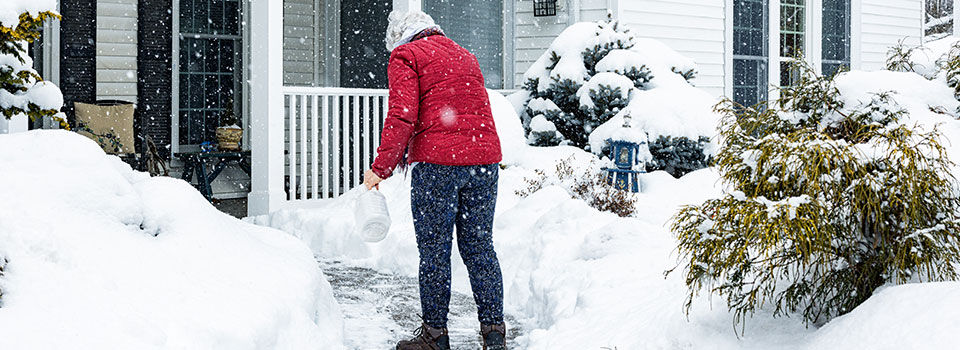
Types of De-icing Products
De-icing salts have been widely used for more than a hundred years, with rock salt or halite, made of sodium chloride, the traditional choice. But today, there are more choices than ever, including calcium chloride, magnesium chloride, and calcium magnesium acetate (CMA).
Each product offers its own balance of melting efficiency, cost, and surface safety, and not every salt will de-ice at the same temperature. Some products combine sodium chloride with other chemicals to improve performance under certain conditions, and special formulations exist to better protect plants and pets.
Rock Salt (Sodium Chloride)
Sodium chloride is an unpurified form of the same salt we use to season food. It is the most widely available and affordable de-icing product for residential use.
On a chemical level, sodium chloride reacts with water and lowers its freezing point to melt ice and to prevent it from re-forming. This ability is somewhat limited because the salt breaks down into only two ions, sodium and chloride, which disrupts the water’s ability to crystallize into ice. Because of this ratio, it is effective only within certain temperature ranges, so it is best used for moderate winters, usually at 15ºF or even 20°F. It also draws heat from the environment in order to work, requiring those relatively warmer temperatures to work.
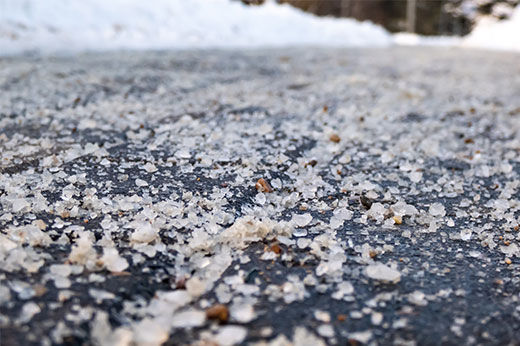
Larger rock salt crystals don’t work as fast, but because they take longer to dissolve, a layer of larger material provides more lasting coverage and slows down the thawing and re-freezing cycle.
Rock salt’s availability and relatively lower cost make it a popular choice as a de-icer, but it has drawbacks. Any chloride-based de-icing product has the potential to damage concrete and corrode metal over long-term and repeated use, and sodium chloride has a higher percentage of that substance than other products.
It also is particularly tough on pets’ paws and on landscaping, and because of that, its environmental impact has led some municipalities to search for other materials to de-ice roads.
But for its budget-friendlier cost and time-tested effectiveness at melting ice in moderate winter weather, rock salt, such as Safe Step Rock Salt/Halite Ice Melt, is a good option.
Calcium Chloride
Calcium chloride is another chloride-based ice-melting product, but it has an advantage over sodium chloride because it works at colder temperatures. Unlike sodium chloride, which draws heat from its surroundings, calcium chloride creates heat, which causes ice to melt much faster and at much lower temps, below 0°F. Because of this, it’s a great choice for severe winter weather and thick ice on surfaces.
However, its higher cost may be a consideration for season-long use or for larger surfaces. But for the toughest winters and thickest ice, a product like DOWFLAKE Xtra Calcium Chloride Ice Melt Flakes will work fast on slick areas.
Magnesium Chloride
Though it’s chloride-based, magnesium chloride is a gentler chemical compound than either traditional rock salt or calcium chloride. It is generally used in formulas that are marketed as safer for pets and landscaping.
Magnesium chloride typically costs more than other ice melt products, but where protecting pets, and delicate plantings or preserving surfaces is a priority, a product like Safe Step Magnesium Chloride Ice Melt Pellets can provide a good balance of effectiveness at colder temperatures and surface protection.
Calcium Magnesium Acetate (CMA)
A non-chloride option that is safer for landscaping and concrete is CMA. It works differently from traditional chloride-based salt compounds by preventing ice from bonding tightly to pavement.
Despite the reduced risk for corrosion when compared with other ice melt products, it works much more slowly and is more expensive. It also isn’t readily available in pure form and is most often found in a blend with other compounds. It carries the same ingestion concerns for pets as other salts, so use with caution.
But for homeowners who don’t need immediate de-icing and whose main priority is protecting surfaces, we recommend Qik Joe Quad Melt Ultra Ice Melt Granules.
Which Ice Melting Salt Should You Choose?
With so many options for de-icing, which product should you choose? The right de-icer for your application will depend on the surface you’re treating, the temperature range it needs to work in, and where your priorities lie: protecting concrete, pets, or landscaping.
You will also need to determine how fast the product has to work to mitigate safety hazards on your property. For steep slopes, dark areas, and heavily traveled walkways, a fast-working salt may be your best choice. For larger, less traveled areas where budget is a concern, slower-acting rock salt may be the right choice.
What Is the Best Salt for Driveways?
Concrete driveways are susceptible to damage from ice melt products, but their large surfaces may make gentler products prohibitively expensive for season-long protection when budget is a priority. However, for new concrete surfaces (less than a year old), preventing damage before it starts is important. In that case, use calcium chloride, magnesium chloride, or CMA to reduce the risk of damage.
For older or non-concrete surfaces, rock salt may be sufficient, as long as temperatures don’t fall below 15 or even 20°F.
What Is the Best Salt for Sidewalks?
Freeze-thaw cycles can damage concrete over time, and some de-icing products can speed up the damage. But to keep pedestrians safe, effective ice removal is a must. The trick is to find a balance between removing ice quickly and protecting the surface.
Residential walkways with fewer travelers or alternative paths may not need the fastest-acting product, and homes without pets or sensitive landscaping may be fine with less-expensive rock salt.
But for sidewalks with heavier pedestrian traffic, especially those traveled by pets, you’ll want something faster acting and safer on paws that’s less damaging to concrete. Pet-safer blends formulated with magnesium chloride may be a good choice for these circumstances, but any de-icer poses an ingestion hazard, so be sure to use only as much as you need to effectively melt ice.
What Is the Best Salt for Steps?
Slick, icy stairs pose one of the biggest risks in winter. A fast-acting ice melt product is ideal, but adding too much can be damaging to surfaces, surrounding landscapes, and pets, so apply sparingly to avoid excess buildup without compromising safety from slips. Choose a product that melts ice faster, such as calcium chloride or magnesium chloride.